
XAUUSD Bears Test $3,693 Make or Break as Gold Bounces
The Gold price November 19 2026 New York session opens with XAUUSD pinned at $3,714.22, roughly $5 above the session low of $3,710.70 and a full $143 below yesterday's high of $3,857.48. Bears have owned this tape for weeks, but the last four hours have produced something they have not seen in a while: a bid. Price is bouncing off the $3,693.27 swing low, and the next two candles decide whether this is a dead-cat bounce or the start of a squeeze.
This is a make-or-break moment for the short side. The daily, H4 and H1 trends all point lower, yet the market is stretched, oversold on the higher timeframes, and sitting directly beneath a nine-touch resistance at $3,719.72. Want to trade this Gold setup automatically? Our AI Trading Bot runs 24/7 on XAU/USD with an 83%+ win rate.
Gold Market Overview
Sentiment is decisively negative. Gold printed a 14-month low near $3,693 in early Asian trade, its weakest level since September 2025, and the fundamental backdrop offers little comfort to bulls. Hawkish Fed minutes released this week show more rate hikes are likely as inflation risks persist, the dollar has recovered its "Liberation Day" losses, and Treasury yields continue to press higher.
The DXY strength is the single biggest driver. A stronger dollar mechanically pressures XAU/USD, and with Fed rate-hike expectations building, the opportunity cost of holding a non-yielding metal keeps rising. Societe Generale's technical desk flagged that Gold failed to hold its 50-day moving average and slipped below a key range, deepening the downtrend. OCBC's Christopher Wong noted the break below $3,800 on a stronger dollar, higher yields and hawkish Fed rhetoric.
One counterpoint deserves attention. An InvestingLive note argues the selloff "may be nearing exhaustion" as growth concerns start to challenge the hawkish narrative. The November Philly Fed came in at 6.3 versus 20.0 expected, a sharp miss that hints at slowing activity. That is the seed of a bounce, not a reversal, but it explains why price is refusing to break $3,693 on the first attempt.
Technical Analysis
The H1 EMA stack is fully bearish: price at $3,714.22 sits below EMA20 at $3,736.00, EMA50 at $3,771.66 and EMA200 at $3,885.92. ADX at 30.94 with DI- at 24.86 versus DI+ at 14.44 confirms an established downtrend, not a range. The H1 candle signal on the last closed bar was a bearish engulfing, which argues the bounce is corrective.
But the momentum picture is turning. RSI on H1 is 37.93 and recovering off oversold, while the MACD histogram has flipped positive at 1.6759 even though the MACD line remains negative at -14.9986. On the higher timeframes, H4 RSI is 24.33 and D1 RSI is 29.43, both deeply oversold. That combination — bearish trend, oversold higher timeframes, positive momentum divergence on the histogram — is the classic setup for a counter-trend bounce into resistance.
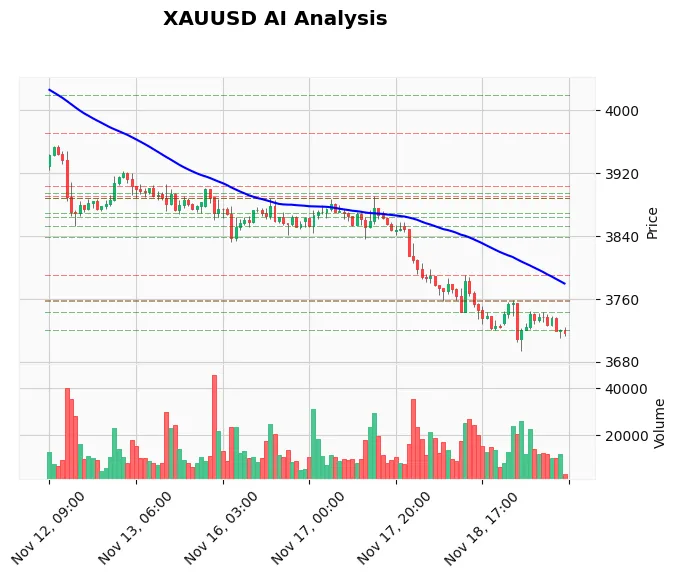
Levels are clean. Resistance above: $3,719.72 (nine touches, broken support now acting as resistance), then $3,742.80 and $3,757.23. Support below: the $3,693.27 swing low, then TradingView S2 at $3,693.17. There is no clustered support beneath that — price is at the bottom of the sampled range, which is exactly the structural void that has produced the winning shorts this month. ATR on H1 is $18.16, so a normal session range is roughly $18 to $36.
Fundamental Drivers
Two headlines matter for the New York session. First, the hawkish Fed minutes continue to drive the dollar and yields higher, and that is the dominant force behind the 14-month low. Second, the Philly Fed miss at 6.3 versus 20.0 expected is the first real crack in the US growth story, and if the market starts pricing slower activity, the rate-hike narrative loses some of its bite.
The sequencing matters more than either headline alone. The Fed minutes were already in the price when Gold broke $3,800, which is why the move extended to $3,693 rather than stalling at the round number. The Philly Fed miss is fresh, and it landed after that break, so the market has not yet decided whether a single soft regional print is enough to slow the Fed. Watch the dollar's reaction rather than the headline itself: if DXY fades on the miss while Gold holds above $3,693.27, the bounce has a fundamental leg to stand on. If DXY grinds higher anyway, the growth scare is being ignored and the downtrend resumes.
There are no high-impact USD events within the next two hours, so there is no timing restriction on entries. The next catalysts to watch are any Fed speaker comments and the ongoing Xi-Trump trade talks, which are keeping the yuan steady against a strong dollar. A hawkish speaker into the close would reinforce the rejection case at $3,719.72; a softer tone would give bulls the excuse to test $3,742.80. If you prefer to let the headlines do the work, our News Trading Bot automates entries around high-impact releases.
Devil's Advocate
The bearish case is not bulletproof. Price is at the bottom of the range with no support below, which cuts both ways: it can accelerate lower, or it can produce a violent short squeeze because there is no overhead supply until $3,719.72. The bullish H1 pin bar and surging M15 momentum are early warning signs that the bounce has legs.
What invalidates the bearish bias? A clean H1 close above $3,719.72 followed by a hold above $3,742.80 would signal the bounce is more than corrective and open the door to $3,757.23 and possibly the $3,790.60 R2. The key reversal level to watch is $3,719.72 — bears need rejection there, not acceptance above it.
Trading Strategy for This Session
The bias remains bearish, but the timing argues against chasing. The cleanest setup is a rejection short at $3,719.72 to $3,725.00, with a stop above $3,739.29 (beyond the resistance and the Bollinger upper band at $3,753.97) and a first target at $3,693.27, then $3,660.00. That is roughly a 1:2 risk-reward on the first target and better on the second.
Work the numbers before you click. Entry at $3,722.00 with a stop at $3,739.29 risks $17.29; the first target at $3,693.27 pays $28.73, and the second at $3,660.00 pays $62.00. That is 1:1.66 on target one and 1:3.58 on target two — which is why scaling half off at $3,693.27 and letting the rest run to $3,660.00 beats closing the whole position at the first level. The stop is deliberately wider than the $18.16 H1 ATR, because a stop inside one ATR of entry gets taken out by noise before the thesis has a chance to play out.
If price instead breaks and holds above $3,742.80, stand aside and wait for the next structural signal. Do not short into a bounce at a level — that is the exact pattern that produced the -323 pip loss at $3,725.668 earlier this month, a trade that entered mid-bounce without waiting for rejection and paid for it. The rule that comes out of that loss: no entry until a candle closes back below the level being tested. For traders who want the structure handled automatically, the Price Action Pro EA reads order blocks and fair value gaps on XAUUSD in real time.
Risk Management
Position sizing matters more than direction here. With ATR at $18.16 on H1, a stop of $20 to $25 is the minimum to avoid noise, which means risking no more than 1% of account equity per trade. The existing SELL at $3,708.67 with a stop at $3,739.29 and target at $3,660.00 remains structurally valid — the stop sits beyond the bounce zone, so let it work rather than tightening into the noise.
If the trade fails and price closes above $3,742.80, accept the loss and wait for the next setup. Do not add to a losing position, and do not average down. The market will offer another entry.
FAQ
Q: What is the key level for Gold in the New York session today?
A: The make-or-break level is $3,719.72 on the topside and $3,693.27 on the downside. A rejection at $3,719.72 keeps the bearish bias intact and targets $3,693.27, then $3,660.00. A clean break above $3,742.80 would invalidate the short setup.
Q: Why is Gold at a 14-month low?
A: Hawkish Fed minutes showing more rate hikes are likely, a stronger dollar, and higher Treasury yields have all pressured the metal. Gold briefly slipped below $3,700 in early Asian trade, its lowest level since September 2025, before bouncing back toward $3,714.
Q: Is the Gold selloff over?
A: Not confirmed. The trend on D1, H4 and H1 is still bearish, but H4 RSI at 24.33 and D1 RSI at 29.43 are deeply oversold, and the MACD histogram on H1 has turned positive. That suggests a bounce is likely, not a reversal. The bearish thesis stays valid unless price closes above $3,742.80.
Q: Where should I place my stop loss on a Gold short today?
A: Above $3,739.29, which is beyond the $3,719.72 resistance and the Bollinger upper band at $3,753.97. That gives the trade room to breathe while keeping risk defined. A stop tighter than $3,730 risks being stopped out by normal ATR noise.
Q: What economic events could move Gold this week?
A: No high-impact USD events are scheduled within the next two hours. Watch for Fed speaker comments and any developments in the Xi-Trump trade talks, both of which could shift the dollar and, by extension, XAU/USD.
Conclusion
Gold is at a genuine inflection point. The trend is bearish across every timeframe, the fundamentals are bearish, and the structural void below $3,693.27 gives bears a clear target. But the market is oversold, bouncing, and sitting directly beneath a nine-touch resistance at $3,719.72. The next move depends on whether that level rejects or breaks.
Trade the reaction, not the prediction. A rejection at $3,719.72 is the clean short; a close above $3,742.80 means stand aside. If you want to execute this plan without watching every candle, our automated Gold bot with 83% win rate handles entries, stops and targets on XAU/USD around the clock.
Trading Gold (XAU/USD) involves significant risk of loss. This content is for informational purposes only and does not constitute financial advice. Always conduct your own research and trade responsibly.