
Is $3,742 the Next Gold Target This Week?
Gold is bouncing off the floor of a one-year decline, and the question every desk is asking into the New York close is whether $3,742 is the next stop. This Gold live analysis November 18 American market breaks down the tape as XAU/USD trades near $3,782 after printing a session low at $3,743.32 — a level that now sits just above the S1 pivot at $3,742.30. The bounce is real, but it is happening inside a structural void with no support below price and a hawkish Fed pressing the dollar higher.
Bears have controlled this market since the open at $3,848.97, and the daily chart is now more than 400 points below its EMA50. The H1 EMA stack is short, ADX reads 33.33 with DI- at 28.18, and price is trapped below VWAP at $3,787.55. That is not a bottoming structure — it is a market catching its breath before the next leg. Want to trade this Gold setup automatically? Our AI Trading Bot runs 24/7 on XAU/USD with an 83%+ win rate.
Gold Market Overview
The macro backdrop is unambiguously bearish for the yellow metal. Reuters reported gold dropping 2% to a more than one-year low as hawkish Fed signals boosted the dollar, and FXStreet confirmed XAU/USD fell below $3,800 for the first time since September 2025 on building Fed rate-hike bets. Strong US retail consumption data released Tuesday reinforced the case, and Fed Governor Waller is now calling for more aggressive action to break the psychology that 3% inflation is the norm.
The dollar has wiped out the entire Trump tariff shock, per Cointribune, and that dollar strength is the single biggest headwind for gold right now. Sentiment on the desk is defensive: the Investing.com headline stream is dominated by "Gold Faces Another Leg Lower as Key Support Levels Turn Into Resistance" and "Gold's Liquidity Trap: Forget the $5,600 Forecast, Watch the Fed." The one counterpoint comes from InvestingLive, which flags a "potential bottom zone" on gold futures — a view worth respecting but not yet confirmed by price.
The immediate catalyst is the FOMC Meeting Minutes, due in roughly 4.9 hours. That is outside the two-hour restriction window, so it does not block a trade now, but it is the event that will decide whether $3,742 holds or breaks. Until then, the market is trading the technicals, and the technicals are bearish.
Technical Analysis
The H1 chart tells a clean story. Price opened at $3,743.50, ran to a high of $3,790.60, and closed the snapshot at $3,782.33 — a 1.04% bounce off the low but still below every meaningful moving average. EMA20 sits at $3,796.91, EMA50 at $3,831.84, and EMA200 at $3,925.41, all stacked above price in perfect bearish order. The H4 confirms the same picture with EMA50 at $3,919.12 and EMA200 at $4,048.40, while the daily EMA50 at $4,089.18 is more than 300 points overhead.
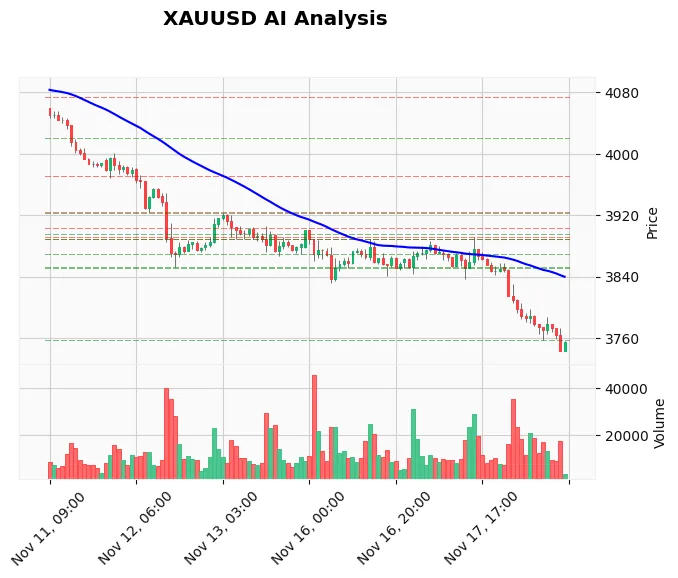
Momentum is weak but not yet exhausted. RSI on H1 reads 40.89, up from the deeply oversold 19.88 logged earlier in the session, while Stochastic sits at 15.05/12.42 — still in oversold territory. MACD is negative at -24.2829 with the signal line at -22.3544 and a histogram of -1.9285, meaning the bearish momentum is intact but flattening. ATR at 19.95 tells you the average H1 range is roughly 20 points, so a move from $3,782 to $3,742 is a two-ATR journey — entirely achievable inside one New York session.
On structure, the H1 is ranging with mixed swings, but the nearest swing high above is $3,886.68 and the nearest swing low below is $3,757.23. The clustered pivot zones are the real map: resistance at $3,850.59 (H1, 20 touches), $3,852.30 (H4, 9 touches), and $3,869.93 (H4, 14 touches) — all broken support now acting as resistance. Below price there is no clustered support at all. The only downside references are the TradingView pivots at S1 $3,742.30 and S2 $3,732.35, with the lower Bollinger band at $3,732.35 reinforcing that zone.
Fundamental Drivers
Two forces are doing the damage. First, the Fed. Waller's call for more aggressive action has shifted the market from "how many cuts" to "how many hikes," and rate-hike bets are now the dominant driver of gold flows. Second, the dollar. The DXY has erased the tariff shock entirely, and a stronger dollar mechanically pressures XAU/USD. Strong US retail data on Tuesday sealed the hawkish case and removed the last argument for a near-term pause.
The FOMC Minutes in 4.9 hours are the next key event. A hawkish read extends the selloff toward $3,715 and potentially $3,690; a dovish surprise could spark the bounce the oversold RSI has been threatening. Watch the dollar reaction first — if the DXY pushes to a fresh high on the release, the minutes are confirming the hike path and gold's path of least resistance stays down through $3,742.30 toward $3,732.35. If the dollar fades instead, the $3,757.23 swing low becomes the launch pad for a retracement into $3,798. If you would rather let a machine handle the headline risk, the News Trading Bot is built to trade high-impact USD events without emotion.
Devil's Advocate
The bearish case has one genuine flaw: price is deeply oversold and sitting only 29 pips below the broken-support-turned-resistance at $3,757.23. Selling the extreme low is how traders get stopped out on a bounce. RSI at 40.89 on H1 and 32.36 on the daily is recovering, and the M15 momentum is described as surging — a retracement toward $3,770-$3,790 is entirely plausible before continuation.
What invalidates the bearish bias? A clean H1 close above $3,798 — the EMA20 and the top of the current range — would signal that the structural void has been filled and the market is transitioning. Above that, $3,850.59 becomes the real test. Until then, rallies are for selling, not for chasing.
Trading Strategy for This Session
The highest-probability play is to sell a retracement into the $3,757-$3,770 broken-support zone rather than chase the $3,782 print. A limit sell at $3,765 with a stop at $3,798 (330 pips, beyond the resistance cluster and the EMA20) targets TP1 at $3,742.30 (the S1 pivot, 227 pips, roughly 0.69x the stop distance), TP2 at $3,715, and TP3 at $3,690. That structure keeps the bearish thesis intact while improving the risk-reward on an oversold market.
Work the numbers before you place the order. From a $3,765 entry, TP1 at $3,742.30 pays 227 pips against 330 pips of risk, so the first scale-out returns about 0.69:1 — you are not paid for the trade until price clears the S1 pivot and runs toward TP2 at $3,715, which is 500 pips and roughly 1.5:1. TP3 at $3,690 stretches to 750 pips, or about 2.3:1. That is why the plan scales out rather than closing everything at the pivot: the edge lives in the extension, not the first target.
Two execution details matter. First, place the limit order rather than entering at market — the $3,757.23 swing low is only 29 pips below the current $3,782 print, and chasing there puts your stop inside the noise of a 20-point ATR session. Second, if price never retraces and breaks $3,742 directly, the setup is invalidated and the next reference is $3,732.35; do not convert a missed limit into a market chase. For traders who want the execution handled mechanically, the Price Action Pro EA trades SMC structure on XAU/USD and can manage the retest entry without screen time.
Risk Management
Position size for a 330-pip stop, not for the 227-pip target. At 0.5% account risk per trade, a $10,000 account risks $50, which on a 330-pip stop means roughly 0.015 lots — small, but survivable across a losing streak. The reward-to-risk on TP1 is 0.69:1, so the edge comes from the higher targets at $3,715 and $3,690, not from the first scale-out.
If the trade fails and price closes above $3,798, take the loss without argument. Do not average down into a hawkish Fed. The FOMC Minutes are the binary event — if you are not comfortable holding through it, flatten before the release and re-enter after the dust settles.
FAQ
Q: What is the next Gold target this week?
A: The immediate downside target is $3,742.30, the S1 pivot and the session low zone. A break there opens $3,732.35 (S2 and the lower Bollinger band), then $3,715 and $3,690 as measured extensions. The upside is capped by $3,798 (EMA20) and $3,850.59 (broken support turned resistance).
Q: Why is gold falling below $3,800?
A: Hawkish Fed signals and a stronger dollar. Reuters reported gold at a more than one-year low as rate-hike bets built, and FXStreet confirmed the break below $3,800 for the first time since September 2025. Strong US retail data and Waller's call for more aggressive action reinforced the move.
Q: Is gold oversold enough to buy?
A: H1 RSI at 40.89 is recovering from 19.88, and Stochastic at 15.05 is still oversold, so a bounce toward $3,770-$3,790 is possible. But oversold is not a buy signal in a structural void with no support below price. Wait for an H1 close above $3,798 before considering the long side.
Q: How will the FOMC Minutes affect gold?
A: A hawkish read extends the selloff toward $3,715 and $3,690. A dovish surprise could trigger the oversold bounce toward $3,798 and $3,850.59. The event is due in roughly 4.9 hours and is the binary catalyst for the rest of the session.
Q: What invalidates the bearish setup?
A: A clean H1 close above $3,798, which is the EMA20 and the top of the current range. That would signal the structural void has been filled and the market is transitioning. Above $3,850.59, the bearish thesis is fully dead.
Conclusion
Gold is bouncing, but the bounce is happening inside a bearish structure with no support below price and a hawkish Fed pressing the dollar. The level that matters most this session is $3,742.30 — hold it and the market consolidates, break it and $3,715 and $3,690 come into play. The smarter entry is a retracement sell into $3,757-$3,770, not a chase at the low.
The FOMC Minutes in 4.9 hours will decide the next leg. Trade the plan, respect the $3,798 invalidation, and let the structure do the work. If you want to run this setup hands-free, our automated Gold bot with 83% win rate executes the same logic on XAU/USD around the clock.
Trading Gold (XAU/USD) involves significant risk of loss. This content is for informational purposes only and does not constitute financial advice. Always conduct your own research and trade responsibly.