
Token Sale Red Flags: A Trader's Guide to the WLFI Crash
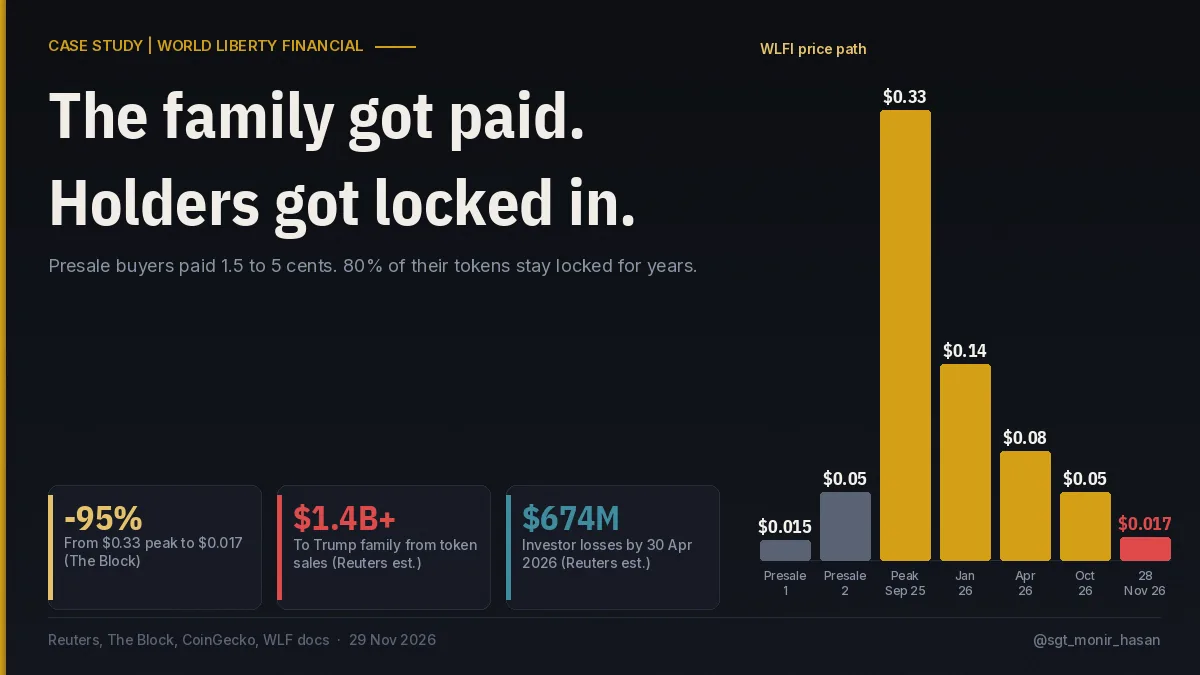
On 28 November 2026, World Liberty Financial's WLFI token dropped by about half in a single night, trading as low as $0.0158 on Binance, according to The Block. That low sits roughly 95% under the $0.33 all-time high The Block cites. For traders who size a position only after they have read the rules, that gap was the moment a term sheet appeared on the chart.
This guide treats WLFI tokenomics as a worked example, using World Liberty's documents, court filings and published reporting. The checks below apply to any token sale: who collects the cash, what a governance token actually grants, how lockups shape the free float, and where a project can raise liquidity while ordinary holders still cannot sell. Nothing below is a forecast or a recommendation to buy or sell WLFI.
What Is a Governance Token Sale — and What WLFI Sold
A governance token usually confers a vote over a protocol, not a share of the company. World Liberty's gold paper is direct: the sole utility of holding WLFI is governance of the WLF Protocol, and the token "provides no right to any return, dividend, airdrop or other distribution."
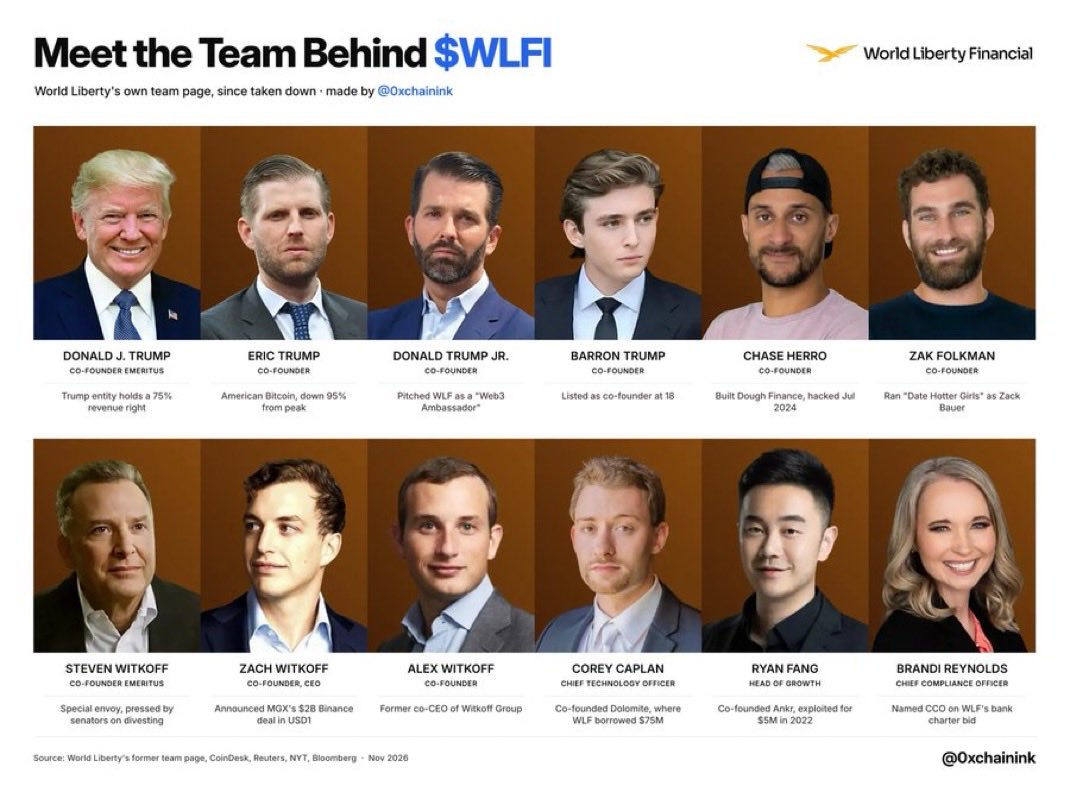
Official tokenomics list a 100 billion total supply. In a public sale from about 14 October 2024 to 14 March 2025, buyers could take up 20 billion units at one and a half cents and a second tranche of 5 billion at five cents; the firm says those rounds raised $550 million. Co-founder entities — DT Marks, AMG and WC Digital Fi — are allocated another 30% of supply, and the team and advisors 3.507%. Reporting has placed Donald Trump, Steve Witkoff, CEO Zach Witkoff, Chase Herro, Zak Folkman and CTO Corey Caplan around the project. At launch, CNBC reported that Barron Trump, then 18 years old, was listed as "Chief DeFi Visionary."
Why It Matters for Retail Token Buyers
Follow the cash, not the headline raise
Under the gold paper, DT Marks DEFI LLC received 22.5 billion WLFI and is entitled to three-quarters of net protocol revenue, including token sale proceeds after agreed expenses and a treasury reserve. AMG and WC Digital Fi receive 7.5 billion tokens and the remaining quarter. Decrypt estimated that about $390 million of the $550 million public sale went to DT Marks under that split. Reuters said Trump's 2025 disclosure showed roughly $800 million linked to World Liberty, of which token sales accounted for over $520 million (Reuters, 30 June 2026). A separate Reuters investigation, summarised by 99Bitcoins because the 9 June 2026 original is paywalled, estimated family token-sale receipts above $1.4 billion after an October 2025 EU (MiCA) filing showed 3 billion fewer tokens than reported a month earlier, a gap Reuters put at $460 million or more. Duke finance professor Campbell Harvey, quoted in that reporting, said it appeared "insiders were dumping." CNBC also reported an ALT5 Sigma purchase of $1.5 billion of tokens at 20 cents, with the family entitled to roughly $500 million, after which ALT5 shares fell 93%. The Wall Street Journal, as relayed by CNBC, said Aryam agreed in January 2025 to pay $500 million for a 49% stake, with $187 million going to Trump entities. Reuters' broader estimate through April 2026 was about $2.3 billion made by the family from crypto ventures and about $2.3 billion lost by outside investors.
Map the unlock before you map the chart
Company unlock documents say that around 1 September 2025, 20% of public-sale tokens became eligible to unlock after holders signed a Token Unlock Agreement. The rest stayed locked. A later proposal, reported by Decrypt and passed in May 2026 with about 99.9% support on the governance forum, set a two-year cliff and then two years of vesting for about 17 billion early-supporter tokens. Holders who do not opt in remain locked indefinitely.
Watch for liquidity that bypasses the public order book
In April 2026, CoinDesk reported that World Liberty posted roughly five billion of the project's own tokens as collateral on Dolomite, co-founded by CTO Corey Caplan, and borrowed about $75 million in stablecoins. More than $40 million, CoinDesk reported, went to Coinbase Prime, and the USD1 pool sat at about 93% utilisation. World Liberty said the loan was "nowhere near liquidation." On 27–28 November, The Block reported that wallets tied to the project sold about $20 million of ether at an estimated $19.3 million loss to defend that loan. World Liberty said it sold no WLFI in the process. Hours later the token fell more than 50% overnight, more than $15 million in leveraged positions were liquidated, and USD1 briefly traded as low as $0.94. Justin Sun has alleged in a federal lawsuit (N.D. Cal. 3:26-cv-03360) that a freeze was added in August 2025 without a holder vote; CoinDesk reported that an address with about 595 million WLFI was blacklisted on 4 September 2025. World Liberty disputes the claims and has countersued.
How to Use It Step by Step
Step 1 — Read the rights, not the brand. If the offering paper says there is no dividend and no claim on residual assets, price the token as a vote plus secondary-market demand, not as a share of the company.
Step 2 — Follow the revenue clause. If three-quarters of net revenue, including sale proceeds, leaves the protocol, most of the cash raised is not runway.
Step 3 — Map the unlock against the free float. Note the share that can be sold on day one, the cliff, the vest, and what happens if you reject the terms.
Step 4 — Check who can obtain cash without an open-market sale of the token. Loans against the project's own token, private placements and sales of company interests can fund a treasury or related parties while the public float stays restricted.
Step 5 — Look for contract-level controls. A blacklist or freeze function can stop a holder from selling even unlocked tokens.
Step 6 — Size for illiquidity, not for the story. If 80% of a purchase cannot be sold, the real exit is a fraction of the notional. Related: Position sizing and risk management
A Real Example: The Path from Presale to the November Low
Presale buyers paid $0.015 or $0.05, per company documents. Around the September 2025 unlock, CoinGecko (via Decrypt) showed about $0.23; this article follows The Block's peak of $0.33 and does not use higher intraday recaps. CoinGecko put market value at about $1.517 billion on 10 November and about $538 million by 29 November, with a price around $0.0169. Reuters described a drop from about $0.039 to about $0.018 overnight. CNBC described a move from about $0.037 to $0.016, with Binance auto-closing perpetuals.
A thin unlock plus a large treasury loan can keep supply off the offer until stress arrives, after which the price can gap.
Frequently Asked Questions
Q: Did World Liberty Financial buyers receive company equity?
A: No. The gold paper says WLFI is for governance and confers no right to returns, dividends or other distributions.
Q: How much have reports attributed to the Trump family from WLFI?
A: Reuters reported roughly $800 million in the 2025 disclosure, including over $520 million from token sales, and has estimated token-sale receipts above $1.4 billion.
Q: How large are the reported losses for WLFI holders?
A: Reuters estimated about $674 million as of 30 April 2026, counting locked tokens as having no value. Public Citizen estimates $1 billion or more.
Q: Why are so many early-bought tokens still unsellable?
A: Only 20% became eligible to unlock around 1 September 2025. A later vote set a two-year cliff and two-year vest; holders who do not accept stay locked.
Q: Has a regulator brought an enforcement case?
A: Senator Warren has asked the SEC to look at the Dolomite loan. A request is not a finding of wrongdoing. Sun has filed suit, and World Liberty has countersued. Public records reviewed here do not show an SEC enforcement action.
Conclusion
WLFI is a useful case study because the structure was written down: no equity claim, a three-quarter claim on net revenue that includes sale proceeds, a tight unlock later extended by a vote, a large loan against the project's own token, and a freeze function now in court. Critics argue that this combination favoured insiders. World Liberty has denied wrongdoing, and the White House has said there are no conflicts of interest.
Run the checklist — rights, revenue split, unlock, alternative liquidity, and contract controls — before the market run. Related: AI trading and crypto markets in 2026.
Buying and trading crypto tokens involves significant risk of loss, including the loss of amounts that cannot be sold while tokens remain locked. This content is for informational purposes only and does not constitute financial advice. Always conduct your own research and trade responsibly.