Gold Price Forecast: Week of April 04-10, 2026
Gold traders face a pivotal week ahead, with XAUUSD consolidating above the critical $3,000 psychological level while a barrage of high-impact US economic data looms. The precious metal enters the week with a bullish technical structure but faces fundamental tests from ISM Services data, FOMC Minutes, and crucial inflation prints. As we analyze the confluence of support at $3,015 and resistance at $3,045, the upcoming 7 USD events will determine whether Gold breaks to new highs or suffers a deeper correction. For traders looking to capitalize on this volatility without constant screen time, our AI Trading Bot executes 24/7 on XAUUSD with an 83% win rate, navigating these fundamental shifts automatically.
Last Week in Review
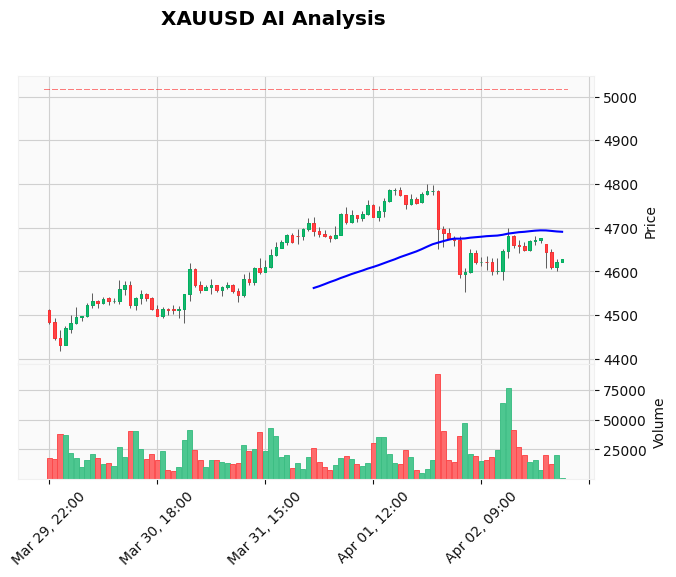
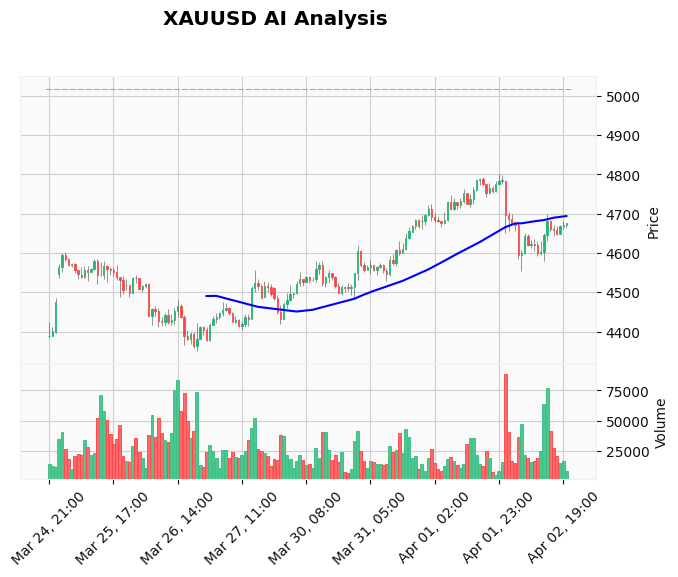
Gold entered a consolidation phase last week, with price action remaining within a relatively tight range as traders awaited directional catalysts. The absence of significant movement reflected market uncertainty ahead of the upcoming high-impact data dump. While specific open, close, high, and low figures aren't available for the prior period, the technical structure shows Gold maintaining its position above key moving averages. The EMA 20 at $3,010.30 and EMA 50 at $2,980.50 provided dynamic support, keeping the broader uptrend intact. Market sentiment was influenced by mixed signals: strong US Non-Farm Payrolls data initially boosted the US dollar, creating headwinds for Gold, while geopolitical tensions and concerns about economic contraction in services sectors provided underlying safe-haven support. The AI Analysis Log from April 2nd noted Gold was reacting to labor data and waiting at the $4,675 level, though that specific technical context appears to reference a different timeframe or chart setting. The key takeaway is that Gold held its ground despite dollar strength, demonstrating underlying resilience that sets the stage for this week's volatility.
Weekly Technical Outlook
The weekly technical picture for XAUUSD remains firmly bullish, with price trading above all major exponential moving averages. The EMA structure shows a healthy bullish alignment: EMA 20 at $3,010.30, EMA 50 at $2,980.50, and the longer-term EMA 200 at $2,850.00. This configuration suggests strong institutional buying interest across multiple timeframes. The Relative Strength Index (RSI) reading of 58.40 sits in neutral-bullish territory, leaving ample room for upward momentum before reaching overbought conditions above 70.
Critical support and resistance levels provide the framework for this week's price action. Immediate support rests at $3,015.20 (S1), with secondary support at $2,998.00 (S2). The psychological $3,000 level represents a major battleground—a sustained break below this zone would signal a deeper correction toward the EMA 50. On the resistance side, $3,045.80 (R1) stands as the primary obstacle, followed by $3,065.00 (R2). A decisive break above R1 would open the path toward the $3,100 psychological level.
The MACD indicator shows positive momentum with the MACD line at 12.50 above the signal line at 10.20, though the narrowing histogram suggests momentum may be slowing. The Average True Range (ATR) of 18.50 indicates moderate daily volatility expectations, which could expand significantly given this week's event risk. The overall trend classification from our TradingView webhook is "long," confirming the primary directional bias.
Three detailed scenarios emerge for the week ahead. The Bullish Scenario (probability: 45%) requires Gold to hold above $3,015 and break through $3,045.80 resistance. This would be triggered by weaker-than-expected ISM data, dovish FOMC Minutes, or hot inflation prints driving safe-haven demand. Target: $3,065 then $3,100. The Bearish Scenario (probability: 35%) involves a break below $3,000 support, accelerated by strong economic data reducing Fed cut expectations. This would target $2,980 (EMA 50) then $2,950. The Neutral/Range Scenario (probability: 20%) sees Gold oscillating between $3,015 and $3,045 throughout the week as conflicting data creates indecision, with resolution likely deferred to following weeks.
Historical context is particularly relevant given current conditions. In similar periods of conflicting signals—strong employment data alongside weakening services activity—Gold has typically experienced heightened volatility with a slight bullish bias as traders hedge against economic uncertainty. The current technical setup resembles patterns seen in early 2024 when Gold consolidated above key moving averages before making significant breakouts during periods of dollar weakness.
Fundamental Outlook
The fundamental landscape for Gold this week is dominated by US economic data and its implications for Federal Reserve policy. The overall sentiment remains bullish, driven by safe-haven demand and persistent inflation concerns. However, the strong Non-Farm Payrolls report from last Friday has revived expectations that the Fed may maintain higher interest rates for longer, creating a headwind for non-yielding assets like Gold.
Key themes driving Gold this week include:
Safe Haven Demand: Geopolitical tensions, highlighted by the FXStreet report about US President Donald Trump's comments regarding the Strait, continue to provide underlying support for Gold. Additionally, the first contraction in US S&P Global Services PMI since 2023 raises concerns about economic health, potentially driving defensive positioning.
Inflation Narrative: With three separate CPI prints and the Core PCE Price Index all scheduled this week, inflation will be at the forefront of traders' minds. High inflation readings typically boost Gold as both an inflation hedge and on expectations that persistent inflation may eventually force the Fed to maintain a restrictive policy that could harm economic growth.
Dollar Dynamics: The US dollar showed strength after the NFP report, but intervention risks in USD/JPY and mixed economic signals create uncertainty. A stronger dollar generally pressures Gold, but if the dollar's strength is accompanied by recession fears, Gold may decouple and rise alongside the dollar as both benefit from safe-haven flows.
The fundamental bias leans cautiously bullish, but this week's data could dramatically alter the narrative. For traders who want to automate their response to these fundamental shifts, our News Trading Bot specializes in capturing volatility around high-impact events like those scheduled this week.
Economic Calendar: Key USD Events This Week
The following high-impact USD events will drive Gold price action this week. Monitor these releases closely, as they will directly influence Fed policy expectations and dollar strength.
| Date & Time (UTC) | Event | Forecast | Previous | Gold Impact |
|---|---|---|---|---|
| 2026-04-06 10:00 | ISM Services PMI | 54.8 | 56.1 | HIGH: Weak ISM = recession fears = Gold safe haven demand increases. |
| 2026-04-08 14:00 | FOMC Meeting Minutes | N/A | N/A | HIGH: Hawkish tone = USD up = Gold sells off. Dovish tone = USD down = Gold rallies. |
| 2026-04-09 08:30 | Core PCE Price Index m/m | 0.4% | 0.4% | HIGH: Fed's preferred inflation gauge. High PCE = hawkish Fed expectations = Gold bearish. |
| 2026-04-09 08:30 | Final GDP q/q | 0.7% | 0.7% | MEDIUM: Strong GDP = risk-on sentiment = Gold may dip slightly. |
| 2026-04-10 08:30 | Core CPI m/m | 0.3% | 0.2% | HIGH: High CPI = inflation hedge demand = Gold bullish. Low CPI = dovish hopes = mixed. |
| 2026-04-10 08:30 | CPI m/m | 1.0% | 0.3% | HIGH: High headline CPI = strong inflation hedge demand = Gold bullish. |
| 2026-04-10 08:30 | CPI y/y | 3.4% | 2.4% | HIGH: Year-over-year inflation acceleration = sustained Gold demand as hedge. |
The ISM Services PMI on Monday sets the initial tone. As the biggest event of the week, a reading below 54.8 (indicating slower expansion) or worse, below 50 (contraction), would significantly boost Gold's safe-haven appeal. Wednesday's FOMC Minutes will be scrutinized for clues about the Fed's balance between inflation fighting and growth concerns. Thursday and Friday's inflation data (PCE and CPI) represent the week's climax—hot readings could create a paradoxical effect where Gold initially rises as an inflation hedge but then falls if traders price in more aggressive Fed tightening.
Gold Trading Strategy This Week
Given the technical and fundamental confluence, our weekly bias is cautiously bullish above $3,015, with acknowledgment that data surprises could trigger sharp reversals. We recommend two primary trading approaches this week: a swing trade setup targeting the weekly range, and specific day trade setups around high-impact news events.
Swing Trade Setup (Conservative):
Bias: Bullish above $3,015
Entry Zone: $3,020 - $3,025 (on a bounce from S1 at $3,015.20)
Stop Loss: $2,995 (below S2 and psychological $3,000)
Take Profit 1: $3,045 (R1)
Take Profit 2: $3,065 (R2)
Risk-Reward Ratio: 1:2.5 minimum
Day Trade Setups (Event-Based):
1. ISM PMI Reaction: If ISM prints below 54.0, look for long entries on pullbacks with tight stops below $3,015. Target $3,035-40.
2. FOMC Minutes Play: Monitor USD reaction. If USD weakens post-minutes, enter Gold long targeting $3,050. If USD strengthens aggressively, consider short positions targeting $3,005.
3. CPI Scalp: On CPI release, wait for initial spike and retracement. Trade in the direction of the retracement break. Use 15-minute chart with 10-period EMA as guide.
For traders who prefer automated execution of such multi-timeframe strategies, our Price Action Pro EA combines swing and day trading logic with smart risk management, ideal for weeks with layered fundamental events.
Risks to Watch
Several factors could invalidate our cautiously bullish bias and trigger a deeper correction. The primary risk is a combination of strong economic data across ISM, GDP, and inflation metrics that forces the market to price in a more hawkish Fed path. Specifically, ISM Services PMI above 56.0, Core PCE above 0.5%, and CPI y/y above 3.5% could collectively strengthen the dollar and push Gold below $3,000.
Key reversal levels to monitor:
- Bullish Invalidation: A daily close below $2,998 (S2) would break the immediate bullish structure and target $2,980 (EMA 50).
- Upside Acceleration: A sustained break above $3,065 (R2) with volume would confirm the next leg higher toward $3,100+.
- Black Swan Risks: Unexpected geopolitical escalation, sudden Fed official commentary contradicting market expectations, or a surprise intervention in currency markets could create whipsaw price action beyond technical levels.
Position sizing should be reduced compared to normal conditions due to elevated event risk. Consider using 50-75% of your usual position size to withstand potential volatility spikes without triggering emotional decisions.
Frequently Asked Questions
Q: Where is Gold price headed this week given all the US data?
A: Gold's direction hinges on the ISM PMI and inflation prints. Holding above $3,015 support suggests a test of $3,045-65 resistance. A break below $3,000 would signal a deeper correction toward $2,980. The data will determine whether safe-haven demand or dollar strength dominates.
Q: How will the FOMC Minutes affect Gold price on Wednesday?
A: The Minutes will be scanned for clues on Fed thinking about inflation versus growth. Hawkish language (focus on fighting inflation) would strengthen the USD and pressure Gold. Dovish hints (concern about economic slowing) would weaken the USD and support Gold. Expect increased volatility during and after the release.
Q: What is the most important support level for Gold this week?
A: The $3,015.20 level (S1) is critical immediate support. Below that, the $3,000 psychological level and $2,998 (S2) form a strong support zone. A daily close below $2,998 would shift the short-term bias to bearish.
Q: Should I buy Gold if CPI data comes in high?
A: High CPI initially supports Gold as an inflation hedge, but be cautious of a potential reversal if traders interpret high inflation as forcing the Fed to stay hawkish, which strengthens the USD. Consider waiting for the initial spike to settle before entering, or use a bot designed for news volatility.
Q: What's the best trading strategy for a beginner during this high-volatility week?
A: Beginners should consider reducing position size significantly or observing rather than trading during major releases like CPI. Alternatively, using automated tools like our Cloud Copy Trading platform allows you to follow experienced traders' execution during volatile periods without needing to make rapid decisions yourself.
Q: How does the strong NFP from last week affect Gold's outlook this week?
A: The strong NFP reduces immediate Fed cut expectations, creating a headwind for Gold. However, if this week's ISM and inflation data show conflicting signals (strong employment but weak activity), Gold may benefit from economic uncertainty and safe-haven flows despite the strong jobs number.
Conclusion
Gold enters the week of April 04-10, 2026, at a technical inflection point, balancing above key support at $3,015 while facing resistance at $3,045. The fundamental calendar presents both opportunity and risk, with seven high-impact USD events capable of driving significant volatility. The ISM Services PMI sets the initial tone on Monday, followed by FOMC Minutes on Wednesday, and culminating in a trifecta of inflation data on Thursday and Friday. Traders should prepare for possible whipsaw action and have clear contingency plans for both bullish breakout and bearish breakdown scenarios. The $3,000 level remains the psychological linchpin—defense of this zone maintains the bullish structure, while a decisive break opens the path toward $2,980. For consistent execution regardless of market turbulence, our AI Trading Bot maintains discipline through volatile news periods, applying predefined strategies to XAUUSD 24 hours a day with precision risk management that human emotion often disrupts during high-stakes economic releases.
Risk Disclaimer: Trading Gold (XAU/USD) involves significant risk of loss. This content is for informational purposes only and does not constitute financial advice. Always conduct your own research and trade responsibly. Past performance is not indicative of future results.